Posts

Salvaging a molding plane blade set
Image
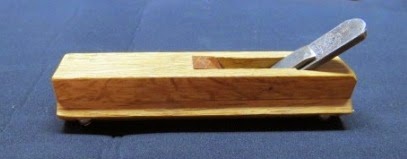
The  ginnan-mentori-kanna  that I wanted to use for a 6mm diameter corner bead was sitting in pieces for months in that essential workshop container - a plastic beer mug.  The former kanna owner had lost the blade geometry and shattered the chipbreaker blade tip, so the blade set had to be reshaped and fitted. The dai needed minor truing. Just like any western molding planes, the sharpening can be challenging. Here is where I started:

Ari shakuri kanna (dovetail plane) - dai rebuild

Image
Ari shakuri (jyakuri) kanna  - dai rebuild: Knowing that I had many sliding dovetails to make,  I looked on eBay for a solid, undamaged, and relatively unused kanna that would suffice as a plane for sliding dovetails. I found this:  I expect old kanna dai to warp over time and this one was no exception, but at least the blades were better than expected.  You will notice this is a fixed (no adjustable fences), single purpose, skewed rabbet plane (cuts 90 degrees), not an ari-shakuri-kanna. However, I originally thought I would alter the dai and main blade to deliver 77 degrees. Once I saw the kink in the dai and the otherwise nice condition of it, I opted to just create a derivative of it and leave the original alone. 

Shoji lantern - take 2

Image
These lanterns are a scaled down version of the one I made a while back but with some minor changes. These are about 5" x 5" x 12" overall.  This time the wood used was Alaskan yellow cedar, compliments of a woodworking friend who gets the trimmings from a hot tub shop near his home.  

Tea shelf

Image
This project began as the focus of an 8 week course given by Jay van Arsdale out of Oakland, CA. It has taken a bit longer than that to complete. The basic design parameters (3 shelves, 4 stringers/legs, overall dimensions of about 24" x 24" x 8" deep, in cherry) were laid down by Jay but the final dimensions, shelf spacing, added features, and finish were left up to the students. 

Resaw primer - with a kataba rip saw

Image
Here is a short episode about resawing boards into thinner boards. In this case I tried my hand at a 3/4" x 14" x 24" piece of reclaimed Port Orford cedar.  The saw was a 300mm rip kataba. Turns out I could have used a larger one.

Recycled cedar - tea tray

Image
This project was straightforward once the resawing of a 14" wide piece of Port Orford cedar with a hand saw (300mm rip kataba) was out of the way. The wood came out of a California Victorian house where it was formerly shelving. The shelves were 1" x 16" x 6' and made of a mix of redwood and POC - all clear, not glued up. Worth taking the time to resaw with care. Note the two tones - the darker face was near the original surface, lighter color is the interior of the board. Port Orford cedar darkens with age.

Product Review - Mitsukawa Juntaro saw set

Image
This is a bit of a departure from my usual project-driven posts but maybe it will help somebody debating a tool purchase, plus there are not many reviews out there that I could find. Mitsukawa Juntaro is a third generation sawmaker in Japan who creates a wide range of saw types. His saws span from machine sharpened semi-production up to traditionally forged, sharpened, and tuned works of blacksmithing art. This set is handmade (at least partly) but I do not know exact details. Usually this is a set of 5 saws, but the little shop in rural Japan I went to only had these 4: Flush trim, rip, crosscut, and hybrid (crosscut with raker teeth). Price for the set of 5 is approx $250 and you can get them at Hidatool.com and elsewhere.