Posts

Long Shoji panel

Image
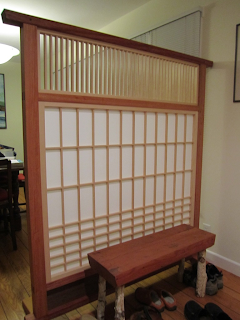
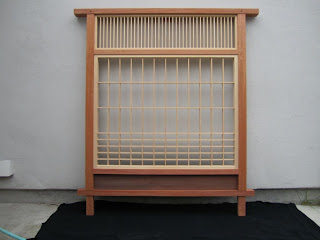
      This fixed shoji panel (right in above photo) is to inset into the frame of a clerestory window that gets too much California sun. The window frame is 8' wide by 18" tall. It needs to match the adjacent smaller panel (left) that I made previously (see this ). To reflect that design I broke the long panel into 3 sections and used similar kumiko (grid) spacing.  

Ryoba (nokogiri) storage boxes

Image
When you buy a (real) good saw - or just about any handmade item of quality - in Japan, it comes in a wooden box. The better of these boxes are made of kiri (paulownia - see left) due to its light weight and stability. Typical saw boxes contain the saw blade and either no handle or the handle is not installed. Makes sense, you can make a shorter box and saws in active use are not usually stored in their original boxes. But hey, I do not have a lot of space and I did not want these particular saws banging around in tight quarters. I am not the original owner and the boxes are long gone, but the saws deserve some respect . My first effort was of old-growth redwood (right) from a former water tank. The box had to fit the 280mm ryoba saw with the handle installed so it ended up 72cm long x 13cm wide x 3cm high. All parts are about 6mm thick. The sides are glued to the top and bottom and are rabbeted so that the top fits over the bottom. The bottom is deeper than the lid. The...

Basic sawhorses

Image
OK, so the strange perspective of this picture is reminiscent of the Stonehenge prop in Spinal Tap, but this saw horse is only 92 cm high. That is the same height as my bench, as was the plan. These are made of decking grade Port Orford cedar but you might consider using something harder - depending on the type of abuse you intend to inflict.

Tsuitate - Part III - conclusion

Image
Tsuitate - bench not included. At long last the journey is over for this free-standing shoji screen (tsuitate). Since the last blog post the tasks required included making feet, tenon prep, making wedges and pins, trimming the top and bottom stiles, chamfering all corners, papering the shoji screen, and lastly finishing the frame. The shoji and top grid (Port Orford Cedar) received no finish once planed. The hipboard is old-growth redwood that did receive finish to protect it a bit.

Tsuitate - rough assembly of freestanding shoji screen

Image
To verify fit of all parts I put everything together yesterday. No major issues and the frame is flat and square without needing to alter it. The top cap rail sits on double tenons at each post and will be pinned upon final assembly. 

Tsuitate frame - some progress

Image
Just because I have not posted in a while does not mean that work has not been ongoing. Here is the state of the frame parts today (love that Blogger rotation feature):   All the pieces were dimensioned by hand from rough-sawn 3" or 2" African Mahogany. None of the boards were straight, the grain is interwoven and planing results varied greatly. To put it bluntly, I would not use this wood for any purpose again. But I will make do here. The best planing results came from a freshly sharpened plane with a chip-breaker sitting as close to the cutting edge as you dare. I tried a higher angle kanna but it did not have a chip-breaker so results were worse. I do not have a high-angle kanna with a chip-breaker but that would probably be best for this type of wood. The pictures in this post show members prior to final planing. That will remove all layout lines.   The joints shown are mostly double tenons with shoulders on 4 sides. These are through-tenons except for...

Tsuitate - Part II

Image
Two shoji panels, back to back. Dim: 125cm x 100cm     This phase of the tsuitate project consists of building two fixed shoji panels that will drop into the mid-section of the tsuitate. Since the 2 panels will be back-to-back they are mirror images of each other and only one will have shoji paper attached. This mirror issue becomes critical if kumiko positions are anything but perfectly symmetrical. Mine were not symmetrical, but they will be next time. Alignment is good but it took extra care to ensure it - due to the asymmetry. Work from the centerline... The two shoji frames back to back. Allowance has to be made to permit removal of the panels to replace the paper. Together the panels will drop into a 2-bu deep groove on the bottom and a deeper groove on the top that will allow you to first lift the panels up into the deep groove and then set them down into the shallower bottom groove - so they are held in place by the top and bottom grooves.  Same ha...